
Fotball coaches and players are always saying “we need tomake the right, or better, decisions”, but do we even know what makes up decison making and if not, than how do we know how we can improve decision making?
Hopefully this helps clear that up a little more so here’s a nice little graphic I made for it:
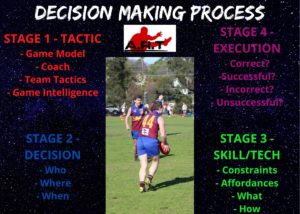
I love a good feedback loop and here’s another one being:
- Tactic
- Decision
- Skill/Technique
- Execution
STAGE #1 – TACTIC
As you can see above I don’t even have decision making first in the decision making loop above because the decision you make is a result of a bunch of other processes you go through to reach it.
The first stage is tactic and this refers to the expecation of the coach and the rest of th team when you receive the ball, or need to pressure the opposition ball carrier.
Both of these game actions can occur allover the ground so different tactics will be expected to be used when the game model indicates so.
So let’s say you receive a free kick in the defensive 50 and the ball takes a relative long time to get back to you and the opposition defense has used this time to get back into their preferred defensive formation.
Most teams will have a different tactic to follow for this slow/closed play game action versus a fast/open play game action – they won’t, and shouldnlt be the same or you’ll be very easy to defend.
So the tactic expected to be used will now dictate where you scan and what you scan for and the information processing phase goes into overdrive.
The tactic is usually just a preferred team based player/ball movement option that all players are in on so that the scanning and information processing phases can be performed as fast as possible and you can start moving the ball before the defense can react and get them on the back foot straight away.
As mentioned above the tactic may be in your team’s game model, it may come from your coach, it may be something you’ve come up with your team line but the more players that can know about it, the better because you donlt just want 1 good passage of play – you want to link passages of play to get the ball as close to your goal as you can, as fast as you can – and that doesn’t just happen with 5 players knowing the correct tactic for that instance and the other 13 playing 13 different games at that time.
In great team’s the average level of game intelligence is usually higher than the opposition and they can assess situations on the fly and with their experience in many scenarios, they are able to predict what to do based on seeing a lot of patterns of play over their careers and this builds their great anticipation capacity.
Great players don’t react faster, they predict better because if you’re reacting your already behind.
I just want to quickly mention that the information processing phase might be the most intricate part of this entire loop as the factors that decide what information if you see as a whole and then see as the most relevant, is based on a host of temporary psychological factors.
For example if the game model tactic is to hit up a 45 degree in board kick into the middle of the ground off half back then if you’re playing well and have just made that kick earlier in the game, then you’ll be very confident to attempt and make that kick versus if you just missed one that resulted in an opposition goal and now that option doesnlt seem as safe to use, and you’ll shift your information gathering to somewhere else, when youer teammates are still working on the initial in board kick tactic.
This is where coaches really need to ask their players questions on what did they see and how did that drive what game action they used immediately after that, whether it was in line with the gane model or not.




One thought on “THE DECISION MAKING PROCESS – STAGE #1 x TACTIC”