4 WEEKS TRAINING PART 6

SESSION #2

WARM UP – GROUNDBALL + HANDBALL REACTION INTO PUSH BACK KICK

You’ll need groups of 3 with 1 ball per group and but not a lot of space, even with the kicking layer but feel free to use more players per group if you don’t have a heap of balls but make it an odd number so each player rotates through each phase of the drill naturally (roll + press up/groundball + handball).
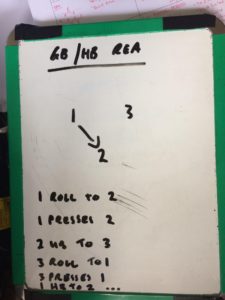
As the image says the sequence is:

  • 1 rolls to 2
  • 1 presses up on 2
  • 2 gathers groundball
  • 3 makes handball receive position
  • 2 gives handball off the deck to 3
  • 3 rolls to 1 and repeat

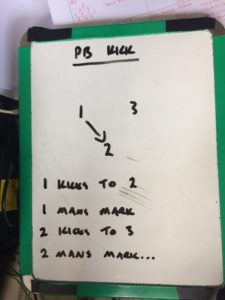
We then layer that into a push back kick with a simialr sequence:

  • 1 kicks to 2
  • 2 marks kick from 1
  • 1 presses up to man the mark
  • 3 makes position to receive kick from 2
  • 2 kicks to 3
  • 2 presses up to man the mark and repeat
KIKCING DEVELOPMENT – CORRIDOR KICK

Set up multiple coned lanes over different distances (below) and set up in groups of 4.
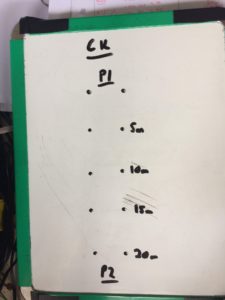
There are several levels to this so the image above is just a sample of how you want to set the cones for a single level but each levels has different measurements which I’ve put in meters but you can do in steps or whatever, just make it consistent.

Level 1 – 15m Long x 1.5m Wide

Level 2 – 20m Long x 1.5m Wide

Level 3 – 10m Long x 1m Wide

Level 4 – 15m Long x 1m Wide

Level 5 – 20m Long x 1m Wide

Initially you might want to set up multiple lanes for the lower levels until players find their edge but you can always add cones to the lower levels quick enough without losing much time.

The challenge to meet before moving up levels is:

Level 1 x 16/20

Level 2 x 14/20

Level 3 x 16/20

Level 4 x 14/20

Level 5 x see what you can do!

DEFENSE – ZONE PRESS UP

MIDFEILD – MOVING THROUGH CONGESTION

As I mentioned at the end of the video, you could make the space bigger and run a 2v2 or so through there with the stationary players as well but you’d need to add a scoring element where making a tackle, interception or pushing the offense outside of the cones is good for more points then the offense getting the ball out of the exit gate to stop them simply guarding the gate because in a game of football you’ll always press the player with the ball.

BACKS – WIDE DRILL

To start out simply run this without any opposition to give players a chance to work together on their ball movement and spread running patterns, telling players that they cannot run the same pattern twice in a row.

Then you can add defenders like this:

1 – Add a defender who can choose to run with options 1 and 3 and the kicker needs to identify the fre option and hit them up.

2 – Switch that defender to now choose to run with options 2 or 3.

3 – Add 2 defenders to go with whoever they want to make it a 4v2.

4 – Add a 3rd defender to make it a 4v3

5 – Add a 4th defender to make it a 4v4 but a defender must man the mark for player 1

To layer again you can simply havea bunch of defenders and send out different numbers of them into each set so the offense must recognise what number advantage/disadvantage they have and play accordingly.

FORWARDS – RUNNING PATTERNS

When we think of forward running patterns we usually think of leading patterns inside 50 but with transition offesne being generated from further away from goal then the good old days, running patterns to get the ball to your half of the ground, then for an inside 50 entry and then a potential goal scoring options all require different running patterns and kicking variations so this is an attempt to cover a few of these.

GAME – FULL GROUND SMALL SIDED TEAMS

Create teams of 8 – 10 should do the trick here who have 1 ball each but players are divided into positions they usually play.

The coach will simply give each team a scenario or pattern to follow from 1 end to the next but players canlt perform the same action 2 sets in a row.

Say 1 team has the patterm of a wide switch kick out of the defensive half.

If 1 of your backline players receives a wide switch kick in set 1 (correct) then they cannot just plonk themselves wide and get the same kick again, they must find another way to acheive the same goal a different way (but staying with their pattern/theme) or in a different part of the ground.

Scenarios or patterns you might look at using include:

  • Full Ground 1 kick, 1 handball
  • Defensive Half Wide/Switch Kick
  • Midfeild Lateral Kick
  • Forward Half 45 Degree Kick
  • All kicks off the line they previous one came in on

You could also include tactical/formation aspects like start up high in a press  and backs need to up past half way before the ball can go past the goal line etc.

The possibilities are endless.

Have 1 team start from 1 end and the other from the opposite end so there is a bit of controlled chaos and congestion.

To go further with this the opposite team players could also be defenders until their own ball comes into their area.

PART 7

FOOTY CLUB BUNDLE

When I originally moved to this membership based site my initial thought was to develop content for coaches, but moreso football clubs in general to purchase and then have on hand for all coaches at their clubs to use as required.

I don’t just want a micro-sector of football coaches to have access to this information, I want everyone in football to have access to this information and help to continuously drive the improvement of local football clubs all over Australia.

So I have finally finished up putting together the Footy Club Bundle.

I really wanted this available more towards the start of the year but life really got in the way and I just couldn’t put the time into it so I let it sit for a while and moved to other things, but we’re here now.

Like I said this has been put together with the aim of football clubs purchasing the program but of course if you’re an individual coach or player, by all means purchase the bundle and go silly but if clubs are going to use this, and they should, then they should make the purchase and as I said, make it available for all their coaches.

The Footy Club Bundle consists of 6 different programs that can beused on pretty much any age group you have at your football club, and you’re only limited by your own ability to deliver them.

They are:

4 WEEKS TRAINING – https://aussierulestraining.com/2021/05/03/4-weeks-training/?yp_rand=925132

  • 8 training sessions that introduce and build various football concepts from session 1 to session 8.

GAME MODEL DEVELOPMENT – https://aussierulestraining.com/2021/04/21/game-model-development-introduction/

  • a 40 part series on developing your very own Game Model

FOOTY FOCUS – https://aussierulestraining.com/2021/04/21/footy-focus-introduction/

  • an 8 week program for junior/youth footballers expecially but again can be used for any grade of football as we’re all too distracted these days.

DECISION MAKING PROCESS – https://aussierulestraining.com/2021/04/28/the-decision-making-process-stage-1-x-tactic/

  • a 4 part look at the decision making and how you can be more specific in your training of it.

BE ACTIVATED – https://aussierulestraining.com/2020/04/02/footy-secrets-4-be-activated/

  • the ultimate, but unknown, pre-game/training prep and injury prevention secret.

SPEED DEVELOPMENT – https://aussierulestraining.com/2020/03/23/footy-secret-1-speed-development/

  • speed is king but you have to train it like a real sprinter would and this program shows you how.

ENERGY SYSTEMS DEVELOPMENT – https://aussierulestraining.com/2020/01/01/aerobic-threshold-training-run-with-a-purpose/

  • a 6 week program that allows you to specifically develop the endurance of each player, at their current level of fitness.

All programs have planty of videos and visuals so you’ll know exactly what to do but if anyone needs any extra information for any of it, feel free to contact me directly.

This is the starting point of the footy club bundle and I might add to it over time so once you’re into the program then you’ll receive all new additions that go into it with no extra cost.

As always I’m always after feedback so if you have any, or idea’s of other programs most football clubs could really benefit from, then let me know and I’ll take a look at it.

4 WEEKS TRAINING

What you’ll find in this section is 16 footy training sessions that I developed to order the training drills I have.

I did originally post week 1 of this last year but have taken it off the regular membership as I lay out the entire 16 session sequence for this.

You may or may not run these as sessions as written but it will definitely show you how to introduce and train concepts of football in a progressive manner.

With that know-how you’ll now have a solid foundation of how to introduce and build other concepts going forward.

PART 2

GAME MODEL DEVELOPMENT PART 39 – WRAP UP

Game Model’s are new to AFL but have been used in other sports, especially Soccer, for a while now.

At local levels of football where skill and fitness abilities can vary dramatically in the 1 side, having a framework of controllable actions like what I’ve laid out here can help build the foundation of your team play.

It can place all players regardless of their skill/fitness levels on an even par as the Game Model initially consists of structure based actions that all players can carry out at pretty much anytime of the game.

Once the foundation is built then once you add the creativity and skill level of your better players, your team cohesivness and success rate should be through the roof.

Unfortunately at local level we tend to work in the reverse by bringing in high level players and their talent then trying to work the rest of the side around them but you’re left without a foundation and if your best players aren’t in form or unavailable, your mid/lower tier players are simply left outmatched with zero foundation and less skill/fitness.

To progress from here you could develop player and movement game model’s which again simply build a foundation for both of those and a basic framework for players to base their decision making off of.

PART 40

THE DECISION MAKING PROCESS – STAGE #1 x TACTIC

Fotball coaches and players are always saying “we need tomake the right, or better, decisions”, but do we even know what makes up decison making and if not, than how do we know how we can improve decision making?

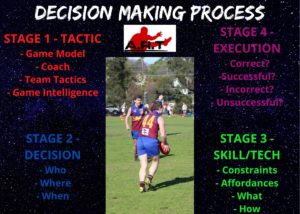
Hopefully this helps clear that up a little more so here’s a nice little graphic I made for it:

I love a good feedback loop and here’s another one being:

  1. Tactic
  2. Decision
  3. Skill/Technique
  4. Execution

STAGE #1 – TACTIC

As you can see above I don’t even have decision making first in the decision making loop above because the decision you make is a result of a bunch of other processes you go through to reach it.

The first stage is tactic and this refers to the expecation of the coach and the rest of th team when you receive the ball, or need to pressure the opposition ball carrier.

Both of these game actions can occur allover the ground so different tactics will be expected to be used when the game model indicates so.

So let’s say you receive a free kick in the defensive 50 and the ball takes a relative long time to get back to you and the opposition defense has used this time to get back into their preferred defensive formation.

Most teams will have a different tactic to follow for this slow/closed play game action versus a fast/open play game action – they won’t, and shouldnlt be the same or you’ll be very easy to defend.

So the tactic expected to be used will now dictate where you scan and what you scan for and the information processing phase goes into overdrive.

The tactic is usually just a preferred team based player/ball movement option that all players are in on so that the scanning and information processing phases can be performed as fast as possible and you can start moving the ball before the defense can react and get them on the back foot straight away.

As mentioned above the tactic may be in your team’s game model, it may come from your coach, it may be something you’ve come up with your team line but the more players that can know about it, the better because you donlt just want 1 good passage of play – you want to link passages of play to get the ball as close to your goal as you can, as fast as you can – and that doesn’t just happen with 5 players knowing the correct tactic for that instance and the other 13 playing 13 different games at that time.

In great team’s the average level of game intelligence is usually higher than the opposition and they can assess situations on the fly and with their experience in many scenarios, they are able to predict what to do based on seeing a lot of patterns of play over their careers and this builds their great anticipation capacity.

Great players don’t react faster, they predict better because if you’re reacting your already behind.

I just want to quickly mention that the information processing phase might be the most intricate part of this entire loop as the factors that decide what information if you see as a whole and then see as the most relevant, is based on a host of temporary psychological factors.

For example if the game model tactic is to hit up a 45 degree in board kick into the middle of the ground off half back then if you’re playing well and have just made that kick earlier in the game, then you’ll be very confident to attempt and make that kick versus if you just missed one that resulted in an opposition goal and now that option doesnlt seem as safe to use, and you’ll shift your information gathering to somewhere else, when youer teammates are still working on the initial in board kick tactic.

This is where coaches really need to ask their players questions on what did they see and how did that drive what game action they used immediately after that, whether it was in line with the gane model or not.

STAGE#2 x DECISION

THE DECISION MAKING PROCESS – STAGE #2 x DECISION

Once the player has recognised what tactic is expected to be used in a particular situation, and once they have processed the information in front of them, now their decision of what to do next is made.

So you get the ball and you know the basic tactic of what’s next which will re-direct your vision to that part of the ground – if you didn’t know the tactic then you’d spend all your time searching for the next tactic instead of moving through the 4 stages of decision making and you’ll be wrapped up in a tackle or foced to bomb the ball for territory with little direction or accuracy.

Things are working well up the ground as well and your teammates have started to move to those spots that you are looking towards the get the ball too.

So now it’s all about who is where the ball preferably needs to get to.

Are they in a lot of space which gives my kick more room for error?

Are they in a tight spaced which givesmy kick less room for error?

Do I have the capability to execute a kick into this tight space?

Can I go back to a time where I executed a similar kick into tight space like this?

Am I feeling confident enough right now to attempt this kick?

Do I feel in safe enough psychological state to attempt this kick in the event that I turn it over?

If not then is this the best option right now?

Are there other and more easier kicks to teammates that I can do right now?

And the loop starts again of which all of this happens in a split second.

So now when you say “you must make the right decision” along with anxiety building language (must, have to etc), you can now start top see the barriers that each player could have up and why they don’t quite make the decisions you think they should.

At this point you can now assist them in making the “right” decision or help them be able to find other options immediately.

STAGE 3 x SKILL/TECHNIQUE

THE DECISION MAKING PROCESS – STAGE #4 x EXECUTION

Stage 4, execution, easily the most used stage of the decision making process for a few reasons.

The main reason being that the coach can clearly see if the ball got to should have got to, and where it needed to go, or not, and this is how players are judged a lot of the time.

But knowing what we do now about decision making, the reasons for this will lye far deeper than most coaches care to know or delve.

The final stage of most learning models ends in autonomy which is the ability to perform an action on demand but the other side of that is that when that action isn’t successful is that by this stage you should also have the ability of self error detection.

This refers to the player being able to assess the action based on the 4 points above:

  • Correct
  • Successful
  • Incorrect
  • Unsuccesful

To take that a bit further:

  • Correct = a correct decision using the correct skill/technique (ball made it to the right person)
  • Successful = a successful decision but incorrect skill/technique (ball made it to the right person but maybe the kick fell short putting them under some form of pressure)
  • Incorrect = an incorrect decision using the correct skill/technique (a safe backwards/lateral kick around half forward that’s not in your game model but a successful kick)
  • Unsuccessful = either or both incorrect decision and skill/technique (kicking error)

If players have reached a level autonomy through your/the coach’s training enviroment and design then players can pretty quickly sum up what correct/incorrect actions were made at any given point of the game and this helps tremendously in building game intelligence.

Inexperienced players will make mistakes and have no idea why they occur and how to correct them, your mid-tier players will have this knowledge for some actions but not all and your experienced players will have this knowledge for most, if not all, game actions.

If you want to make your coaching gig a lot easier than presenting a framework like this can assist them in some self learning which usually sticks a lot more in the brain then simply being told from someone else.

THE DECISION MAKING PROCESS – STAGE #3 x SKILL/TECHNIQUE

You have now made your decision of what to do with the ball that falls in line with your team’s game model so now you move to phase 3 being skill/technique which refers to what skill and/or technique do I need to use to make this decision successful.

What you need to take into account here are constraints (things that restrict what you can do right now), affordances (things that present opportunities for you right now), what they are and how can use work around or with them.

Does the player I am about to kick to prefer softer kicks than hard kicks?

If I don’t kick it straight enough then do they have the ability to quickly react to the ball and be able move to make the mark?

Does the receiver prefer to receive the ball in open space v closed space?

Is there a wind that could throw my kick off line?

Is the ball slippery which might affect my ball drop and ball contact?

Has an oppsootion playerbeen dragged out of the tight spacde by another teammate providing the affordance of extra space to 1 side of my designated target?

Is the player on the mark close (constraint) or far away (affordance) from me?

What do I need to alter if they are close to me?

If I don’t move away from them what type will I have to do?

If I do move away from them then what other kicks are open to me now?

All these thoughts and more again occur in a split second but it is all this information that now brings you to your technique as now you  know what type of kick you need to do.

This is another reason why kicking mechanics assessment is way overrated in my book because every single kick you do in a game, even set shot goial kicking, is different as they are all performed under different conditions (distance, angle, ground side etc).

STAGE 4 x EXECUTION

GAME MODEL DEVELOPMENT PART 40 – DIRECTORY

  1. https://aussierulestraining.com/2021/04/21/game-model-development-introduction/
  2. https://aussierulestraining.com/2021/04/21/game-model-development-part-2-game-moments-possession-status/
  3. https://aussierulestraining.com/2021/04/21/game-model-development-part-3-macro-moments/
  4. https://aussierulestraining.com/2021/04/21/game-model-development-part-4-micro-moments/
  5. https://aussierulestraining.com/2021/04/21/game-model-development-part-5-transition-defense/
  6. https://aussierulestraining.com/2021/04/21/game-model-development-part-6-transition-defense-2/
  7. https://aussierulestraining.com/2021/04/21/game-model-development-part-7-transition-defense/
  8. https://aussierulestraining.com/2021/04/21/game-model-development-part-8-transition-defense/
  9. https://aussierulestraining.com/2021/04/21/game-model-development-part-9-transition-defense/
  10. https://aussierulestraining.com/2021/04/21/game-model-development-part-10-transition-defense/
  11. https://aussierulestraining.com/2021/04/21/game-model-development-part-11-transition-defense/
  12. https://aussierulestraining.com/2021/04/21/game-model-development-part-12-transition-defense/
  13. https://aussierulestraining.com/2021/04/21/game-model-development-part-13-defense/
  14. https://aussierulestraining.com/2021/04/21/game-model-development-part-14-defense/
  15. https://aussierulestraining.com/2021/04/21/game-model-development-part-15-defense/
  16. https://aussierulestraining.com/2021/04/21/game-model-development-part-16-defense/
  17. https://aussierulestraining.com/2021/04/21/game-model-development-part-17-defense/
  18. https://aussierulestraining.com/2021/04/21/game-model-development-part-18-defense/
  19. https://aussierulestraining.com/2021/04/21/game-model-development-part-19-transition-offense/
  20. https://aussierulestraining.com/2021/04/21/game-model-development-part-20-transition-offense/
  21. https://aussierulestraining.com/2021/04/21/game-model-development-part-21-transition-offense/
  22. https://aussierulestraining.com/2021/04/21/game-model-development-part-22-transition-offense/
  23. https://aussierulestraining.com/2021/04/21/game-model-development-part-23-transition-offense/
  24. https://aussierulestraining.com/2021/04/21/game-model-development-part-24-transition-offense/
  25. https://aussierulestraining.com/2021/04/21/game-model-development-part-25-transition-offense/
  26. https://aussierulestraining.com/2021/04/21/game-model-development-part-26-transition-offense/
  27. https://aussierulestraining.com/2021/04/21/game-model-development-part-27-transition-offense/
  28. https://aussierulestraining.com/2021/04/21/game-model-development-part-28-transition-offense/
  29. https://aussierulestraining.com/2021/04/21/game-model-development-part-29-offense/
  30. https://aussierulestraining.com/2021/04/21/game-model-development-part-30-offense/
  31. https://aussierulestraining.com/2021/04/21/game-model-development-part-31-offense/
  32. https://aussierulestraining.com/2021/04/21/game-model-development-part-32-offense/
  33. https://aussierulestraining.com/2021/04/21/game-model-develoment-part-33-offense/
  34. https://aussierulestraining.com/2021/04/21/game-model-develoment-part-34-offense/
  35. https://aussierulestraining.com/2021/04/21/game-model-develoment-part-35-offense/
  36. https://aussierulestraining.com/2021/04/21/game-model-develoment-part-36-offense/
  37. https://aussierulestraining.com/2021/04/21/game-model-develoment-part-37-offense/
  38. https://aussierulestraining.com/2021/04/21/game-model-develoment-part-38-offense/
  39. https://aussierulestraining.com/2021/04/21/game-model-develoment-part-39-offense/

FOOTY FOCUS COMPLETION

8 weeks ago you started this course.

You made a conscious decision to improve yourself as a footballer and as a person.

You identified your own specific deficiencies and made a pact with yourself, the hardest person to bargain with, to make them a point of focus to improve upon.

You were given, and completed, 4 different objectives – 24 objectives overall – each week.

You took them head on and smashed them out of the park.

You’ve now built self governing psychological tools that will assist you with being able to focus on specific tasks at hand without distraction, a staple of elite sportsman who can make perfect decisions in times of absolute chaos.

You performed various skill-based tasks, most of which get completely overlooked once you exit under 10’s, but without a solid and constantly reinforced foundation, when times get tough and things aren’t going your well, that’s all you’re left with – the work you’ve done religiously leading up to that point in time.

The physical objectives, specifically focusing on long duration isometrics, combined hard physical exertion with the ability to maintain psychological focus under physical heat – the last 10mins of a Grand Final right there.

On a personal level you’ve completed tasks that force you to look at everything around besides yourself. This awareness is what builds your character through empathy, integrity and honesty – the type of stuff AFL captain’s simply ooze of.

I hope that at certain points in the program things got reasonably hard and were able to confidently take them as a challenge over a roadblock.

Above all I hope you enjoyed the different aspects of the program and would love to hear/read your feedback on the program (via email) as this program has to be exactly what it preaches – constantly improving.

Be sure to keep up to date with everything that goes on at Aussie Rules Training by joining the outer at the website, Facebook, Twitter, Instagram, Youtube social media platforms and the emailing list.

Thank you for high effort and involvement in the Footy Focus Course and let me know in any other way I can be of assistance to you in the future.