GAME MOMENT x OFFENSE
POSSESSION STATUS x IN POSSESSION
MACRO MOMENT x TRY TO SCORE
MICRO MOMENT x FRONT ON LEADING OPTIONS

GAME MOMENT x OFFENSE
POSSESSION STATUS x IN POSSESSION
MACRO MOMENT x TRY TO SCORE
MICRO MOMENT x FRONT ON LEADING OPTIONS
GAME MOMENT x OFFENSE
POSSESSION STATUS x IN POSSESSION
MACRO MOMENT x TRY TO SCORE
MICRO MOMENT x FORWARDS WORK THEIR MAN EARLY
GAME MOMENT x OFFENSE
POSSESSION STATUS x POSSESSION LOSS
MACRO MOMENT x FORWARD HALF DEFENSIVE PRESS
MICRO MOMENT x COMPRESS SPACE/BACK 6 MOVE AS 1 AS THE BALL MOVES
GAME MOMENT x OFFENSE
POSSESSION STATUS x POSSESSION LOSS
MACRO MOMENT x FORWARD HALF DEFENSIVE PRESS
MICRO MOMENT x IDENTIFY THE MOST DANGEROUS OPPOSITION OUTLETS
GAME MOMENT x OFFENSE
POSSESSION STATUS x POSSESSION LOSS
MACRO MOMENT x FORWARD HALF DEFENSIVE PRESS
MICRO MOMENT x 1 METER RULE/TACKLE OR CORRAL
GAME MOMENT x OFFENSE
POSSESSION STATUS x POSSESSION LOSS
MACRO MOMENT x FORWARD HALF DEFENSIVE PRESS
MICRO MOMENT x KICK OUT ZONE FORMATION
As your game model is now about to get pretty busy, I’d suggest moving to an Excel spreadsheet or something similar like I have here:
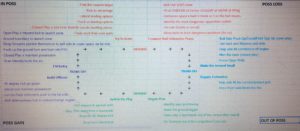
Micro moments are exactly that, the micro moments that make up your macro moments devised from your game moment.
It’s the process that goes into achieving the result.
So you might say for offense your game moment is “trying to score”, like I have above, and fair enough considering that’s how you win.
But what goes into that.
How do player move to create this?
How should the ball move to create this?
How should both of these happen when the ball is different positions on the ground?
How should they occur under fast and slow play conditions?
Do you want to play a similar style regardless of the slow/fast play or do you wanna be able to alter playing styles depending on the flow of the game or the position of the ball?
Like I said this the real thinking bit of the development of the game model.
I will go through each game moment with what I laid out above, remembering I did it almost 2 years ago so somethings are still relevant and some aren’t so much but I’ll address them in the videos.
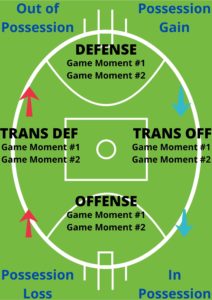
There are 4 game moments in team sport and within a game you are always in 1 of them but they can switch in a split second and in any order, especially in such a chaotic sport like football.
They are:
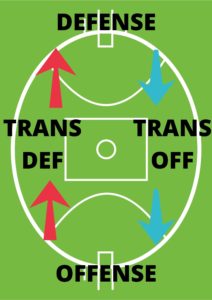
They can each be referred to game actions in specific parts of the ground but again they can occur anywhere on the feild and that part is also important to understand.
The image below shows the basic game moment loop it follows but as stated, that order is not always the same.
The next part to add into the game model template is the possession status which matches up with the game moments, but generally overlap from 1 game moment to the next and is what can show you how they can occur in all different orders throughout the 1 play.
They are:
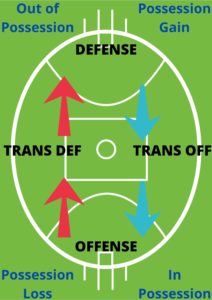
That’s the basic template.
I discovered game models about 4 years ago as my transition from playing to coaching began to really take shape and I’ve been a big fan of them ever since.
I usd the term game model over game plan because I belive a game model is vastly different from what a game plan is thought to be – especially in football circles.
Game plans usually revolve around specific ball movement, which is part of the game model, and midfeild set ups which is going with ther what you want to happen mantra versus the what does happen mantra that I follow.
Definitely train for what you want to happen but I belive it’sbuilt off of your foundation of already being extremely efficient with dealing with what does happen, not the other way around.
For example all local football clubs love training drills to look clean and pretty with predictable training drills which is great and all but it’s not a true reflection of what happens in agame which is messy and unpredictable.
I like to use game models to show foundation-based aspects of football that all players can perform, regardless of talent level, and as long as they put the time in to memorise the game model and are then disciplined enough to carry it out on game day, they’ll be solid contributors to your team each and every week whether they touch the ball 20 times or 5 times.
The different points I’ve highlighted here is from a game model I developed about a year and half ago and with football trends, and rules, changing pretty much every year at this point it’s not based on what I would do right now and also every team’s game model will be specific to them in regards to player personel, coaching beliefs, culture, ground size etc, so feel free to delete and add in what you feel is best into your own game modelfor best results.
Once you’ve completed your game model then feel free to send me a copy and I can take a look at it and see if it could be improved upon or maybe just to challenge a few things just make sure it’s rock solid because once it’s done you don’t want to be shifting the goal posts on your players or they’ll be in a constant state of confucison which is the total opposite of why a game model is developed in the first place.
There’s a few moving parts in all of this but it all ties in nicely at the end so strap yourself in!
With our basic template completed it’s time to put your coaching hat on nice and tight as we move to macro moments.
Macro moments are the big rocks of your game moments – transition defense, defense, transition offense and offense.
I would stick to 2 macro moments per game moment, at least to start with.
Be sure to keep in mind the possession status as well which will help dictate what specific aspects you need to focus on at this time and when I say time, it could be as quick as 1-2 secs so the ability get the game model to memory and then to be able to shift your focus of attention on game dayis crucial.
With time of huge importance in football, especially if you don’t have a lot of it, the game model actually helps quicken up decision making and keeps “lag” time to a minimum.
Our graphic now shifts to this: